You Are Wearing a Patch With an FDA-Flagged Neurotoxin on Your Skin. Here Is What That Means.
The desire to lose weight without effort is completely understandable. Life is demanding. Time is short. Willpower is finite. When something promises results without asking much in return, of course it is appealing.
But wanting something to work is not the same as it being safe.
The question worth asking before you buy any weight loss product is not "does this work?" The first question is: what is this doing to my body while I find out?
Because there is a version of this story where you spend months absorbing compounds through your skin, compounds that carry documented risks to your kidneys and nervous system, and the only thing you lose is your health.
There is another option. It does not come in a box. It does not have a TikTok unboxing video. But it has decades of research behind it, a known safety profile, and results that are real.
Before you decide, you deserve to know what you are actually choosing between.
The Promise
A patch. Applied once a day. No diet changes. No pills. No effort.
That is the pitch behind the Akemi Slim Patch, one of a growing category of transdermal weight loss products gaining traction with people in their teens and twenties. The branding is clean. The price point is accessible. The word "natural" appears in nearly every sentence of the product description.
It feels safe. That is entirely intentional.
But here is the question no one in the marketing materials asks: what happens when you absorb these compounds through your skin every single day?
What Is Actually in This Patch
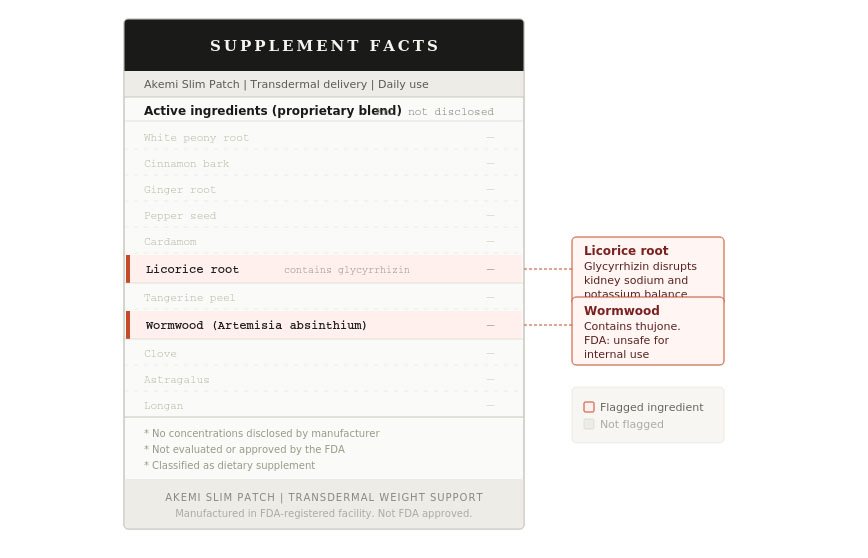
The formula contains 11 herbs: white peony root, cinnamon, ginger, pepper seed, cardamom, licorice root, tangerine peel, wormwood, clove, astragalus, and longan.
The concentrations of each ingredient are not disclosed. You do not know how much of anything enters your bloodstream. Neither does the company, at least not publicly.
Two ingredients deserve your full attention before you read another word.
Wormwood
Wormwood is listed as an active ingredient in this patch.
The FDA has classified wormwood as unsafe for internal use. Not cautiously safe. Not conditionally safe. Unsafe.
The reason is thujone, a compound present in every part of the wormwood plant. Thujone is a neurotoxin. It works by blocking GABA receptors in your brain, the same receptors that regulate nerve activity and prevent seizures. Research has linked thujone exposure to vomiting, tremors, seizures, and kidney failure.
Using wormwood for longer than four weeks, at any dose, carries documented risk of nervous system damage.
Now consider this: the Akemi Slim Patch is marketed as a daily habit. Worn continuously. Week after week.
The transdermal delivery method bypasses your digestive system entirely. Your gut and liver normally intercept and limit how much of a compound reaches your blood. A skin patch removes that filter. Compounds go directly into circulation.
There is no published safety data on the long-term transdermal absorption of wormwood extract. None. The product is sold anyway.
Licorice Root
The second ingredient that warrants serious attention is licorice root.
Licorice contains glycyrrhizin, a compound that behaves like aldosterone in your body. Aldosterone is a hormone that controls sodium and potassium balance in your kidneys. When glycyrrhizin mimics it, your kidneys start retaining sodium and excreting potassium.
The downstream effects are not minor. They include high blood pressure, muscle weakness, fluid retention, and in documented cases, cardiac arrest.
The National Institutes of Health flags licorice as a risk for anyone with hypertension, kidney disease, or heart conditions. Young adults carry undiagnosed versions of all three more often than they realize. Hypertension now affects roughly 1 in 4 adults under 40 in the United States. Many do not know it.
Consistent daily absorption of glycyrrhizin does not need to reach a dramatic threshold to cause problems. Low-level, chronic exposure to compounds that affect kidney function adds up.
"Natural" Does Not Mean Safe
This is the core of how these products sell.
The supplement industry has successfully trained consumers, particularly younger ones, to treat "natural" and "plant-based" as synonyms for "harmless." They are not.
Thujone is natural. Glycyrrhizin is natural. Arsenic is natural. Origin has no bearing on toxicity. What matters is dose, delivery method, frequency of use, and your individual biology.
A transdermal patch delivering wormwood extract into your bloodstream daily is not the same as drinking ginger tea. The mechanism is completely different. The exposure level is uncontrolled. The cumulative effect over months is unknown.
Here is what is also worth asking: if the ingredient concentrations are not disclosed, how does anyone, including the manufacturer, know the dose is safe?
The Regulatory Gap You Are Living In
The Akemi Slim Patch is classified as a dietary supplement. In the United States, dietary supplements do not require FDA approval before they go to market. The FDA can act after a product causes harm. It cannot stop a product from being sold based on theoretical risk.
This means the burden of safety research falls on you.
The company markets the patch aggressively to people who are unlikely to cross-reference the FDA's wormwood classification, read NIH monographs on glycyrrhizin, or search for published transdermal absorption studies on herbal compounds. That is not an accident.
You are not the target market because you are well-informed about phytochemicals. You are the target market because you want a result fast and the product looks credible.
What a Low Carb Diet Does Instead
A low carb approach reduces daily carbohydrate intake, ideally below 50 grams. When carbohydrate availability drops, your body shifts to burning stored fat for fuel. This process is called ketosis. It is one of the most studied metabolic states in clinical nutrition.
The documented effects in research are consistent across populations:
Appetite drops. This happens because low carb diets lower ghrelin, the hormone that signals hunger, and stabilize blood sugar, which eliminates the spike-and-crash cycle that triggers cravings. The desire to eat less is biological, not willpower-dependent.
Weight loss occurs. Initial losses of 2 to 4 pounds in the first week are common, mostly from reduced water retention. Sustained fat loss follows in subsequent weeks, particularly around the abdomen.
Energy stabilizes. Without blood sugar fluctuations, most people report more consistent energy throughout the day, with less afternoon fatigue.
These are not claims. They are replicable results documented across hundreds of peer-reviewed studies. The mechanism is understood. The safety profile is established. The risks are known and manageable.
Compare that to a patch with undisclosed doses of a neurotoxin-containing herb delivered directly into your bloodstream.
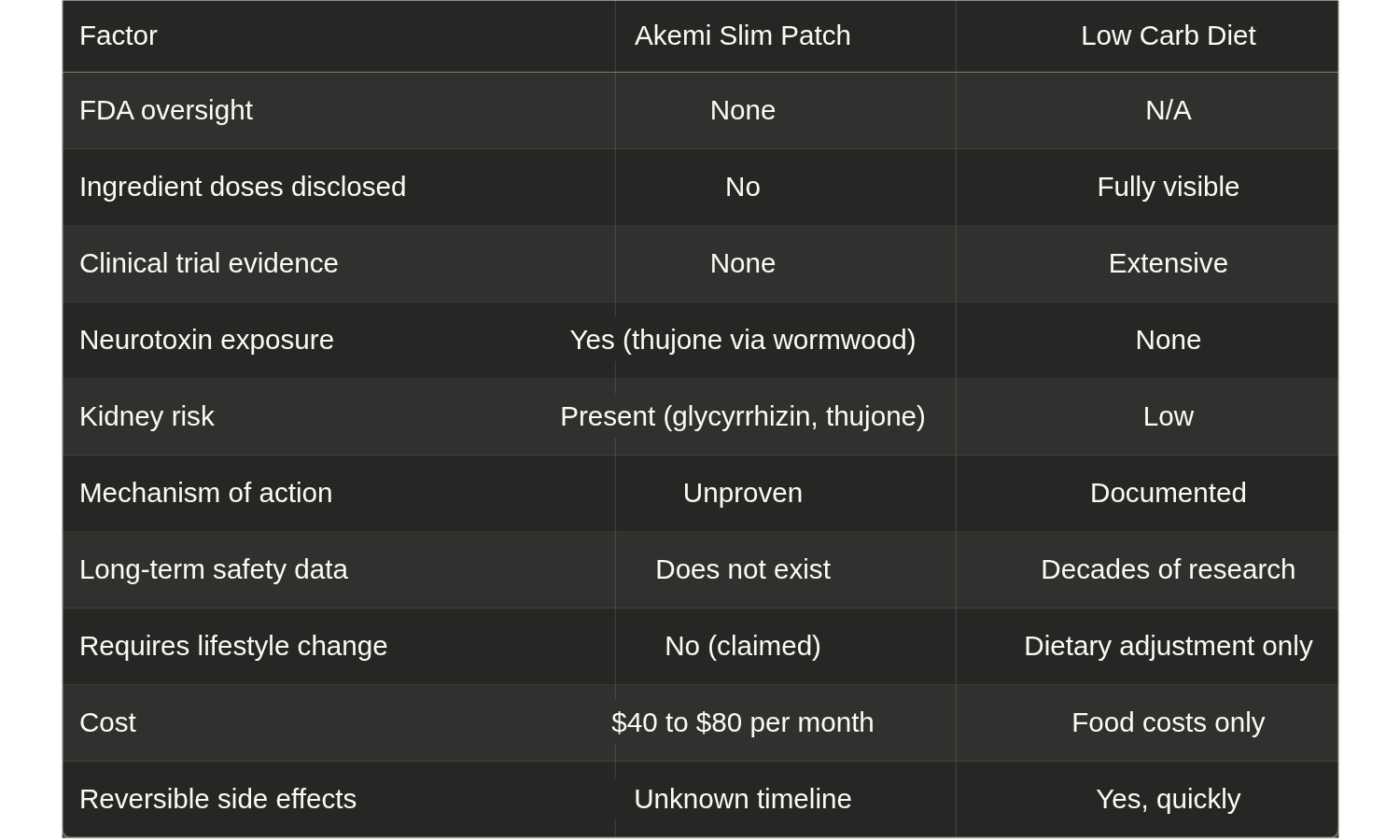
The Comparison No One Puts Side by Side
What You Should Look Up
If this article raises questions, that is the point. Here is where to start:
Search the FDA's published list of unsafe herbs and wormwood's classification. Read the NIH National Center for Complementary and Integrative Health entry on licorice root. Look up glycyrrhizin and pseudoaldosteronism, the condition it causes in the kidneys. Search for published randomized controlled trials on low carb diets and weight loss.
Then search for published randomized controlled trials on transdermal herb patches and weight loss.
You will find hundreds of results for the first search. You will find almost nothing for the second.
That gap is the answer.
One Last Thing
The desire to lose weight fast is not a character flaw. The supplement industry spends billions of dollars every year making sure that desire leads to a purchase before it leads to a question.
The question is always worth asking first.
What is in this? What does it do to my body? Who reviewed that claim?
A patch with wormwood and undisclosed concentrations of kidney-affecting compounds, worn daily, is not a wellness tool. It is an uncontrolled experiment. And you are the subject.
You deserve to know that before you buy it.
This article is for educational purposes only and does not constitute medical advice. Consult a healthcare provider before starting any supplement or dietary program.